Monday, 4 December 2017

Book Review: Trapped Under the Sea

This book has been in my "To Read" list for a very long time. Only when the Breakthrough Magazine (current issue) wrote a review about this book, it gave me the final push to read this book without any delay. But once I started reading, it was so gripping and thrilling that I had to complete the book within a week.

The book describes the tragedy which occurred during construction of a waste treatment plant in Boston Harbor, USA. As with the most sewage outfall tunnels, this project has diffuser lines installed towards the end of the tunnel to disperse the treated sewage. The book describes about an incident where divers were sent into ~15km long un-ventilated tunnel (with individual breathing system) to  remove the safety plugs installed at the tunnel and diffuser connections.

Deer Island Treatment Plant and Sewage Outfall tunnels (source)
The author describes the the dangers faced by the workers due to the inability of the tunnel designers, constructors, and management who could have worked together to solve the issue. Rather they tried to insulate themselves from liabilities and to push the risks on to the other parties which made their relationship thoroughly dysfunctional. At the end, the dangerous cocktail of time, money, stubbornness and frustration (near the end of over budget , long delayed project) has caused the lives of workers.

Having a bit of experience myself in working for mines, tunnels and claustrophobic hyperbaric chambers, I have some idea of the "adventure" and risk that the job entitles to the people working in such conditions on a daily basis. Even then, I found the book baffling and I found it hard to digest the fact that these divers were exposed to such extreme risks.


Entering a hyperbaric chamber 
But this seem to be the reality of lump-sum low bid construction. The company bids the bare minimum and can make profit only when the cost turn out to be unusually low. In order to do so, the company weighs in too much on the responsibility that it assigns to a third party and the farther the managers are from the actual decision making, the greater is their tolerance for risk. In such an arrangement, as the problem arrives, the priority is not on solving them but to figure out who's is to blame and who is going to pay. Hence the problem gets a lot harder and more expensive to fix. Once relationship gets poisoned, the parties become so fixed in their position that they could no longer trust the intention of the other side.

If there is any incident, it is usually caused by a series of small bad decisions made by many individuals, none of which on its own would have been enough to produce a failure.The author draws the comparison with "Swiss cheese" model of failure which is often used by safety scientists. When the holes in organizational defects line up in ways that had not been foreseen, the problem require rapid interpretation and responses and here it is when that things can go wrong. 

I got to learn very good lessons for my professional as well as personal life based on the narrative presented in the book. I could immediately relate to some of my projects where opposing sides become fixed in their positions, relying on cognitive shortcuts as they are locked in adversarial contest. Some of my take away points are:

  • Accidents do happen when confidence runs high and tolerance for delay dips low. This should not let people accept looser standards in the name of greater speed. The more people do something without suffering bad outcome, the harder it could become to remain aware of the risks associated with that behavior.
  • Engineer should have a good sense and strong stomach to say no whenever he/she ethically believes so. An engineer has to plan to follow proven protocols rather than panic gut decisions.
Overall, a very interesting story documenting the heroism of the workers and mis-management of design and contract administration.

Sunday, 22 October 2017

Hulme Prize 2017

This year, I was privileged to get two of my papers shortlisted for the annual competition for the best technical papers from young engineers on subjects  associated with tunnelling and underground construction. The three papers shortlisted for this year are:


  • Mined Tunnel Monitoring as a Part of Observational Approach – a Case Study 

  • Latest Development in Horizontal Grouting for Cross Passages in Thomson East Coast Line C1-C2 
    • By Ms Jasmine Lim, Land Transport Authority

Presentation of the shortlisted papers were held on 17th August 2017 at the SMRT Auditorium and prizes for the winners were distributed during TUCSS Annual Lecture at Stephen Riady Auditorium At One Marina Boulevard, Singapore. The first paper was presented by my co-author and I presented the second paper (summary of the paper is available in my previous post).


The Hulme Prize was set up by TUCSS in 1999 in honour of Mr. Terry Hulme, Honorary Member of  TUCSS,  for  his  outstanding  contribution  to  TUCSS  and  Tunnelling  in  Singapore. It  is  an  annual competition  for  the  best  technical  paper and the winners are presented with a cash prize and citation.

Saturday, 30 September 2017

SCL / NATM tunnel lining displacement monitoring - Case Study

The observational method is widely used in tunnelling works. For a successful implementation of observational method in tunnelling, an efficient monitoring, data evaluation and interpretation on site is of prime importance. Reviewing the common practice on sites in Singapore, it could be said that, there is a potential for improvement in the data collection and interpretation techniques employed for mined tunnelling works in Singapore. Although there are several advanced tools available in the market for data handling, evaluation and interpretation; there is a scope for development of simple and easy to use tools, to properly handle the spatial displacement measurements. With the adoption of Eurocode 7 in Singapore, it is further more important to evaluate the mined tunnel movements, continuously update the geotechnical model & adjust the excavation/support system to suit the actual ground conditions.

This post presents simple implementation of absolute tunnel displacements visualization in the ubiquitous spreadsheet software. A practical procedure for predicting and comparing displacement behind the face in relation to face advance and time is presented with a case study of mined tunnel in shallow overburden condition. The case study considers a mined tunnel which is in overburden ranging from 6m to 8m under a road with significant traffic as well as major utilities and services. The design included temporary excavation support using staggered piperoof,  sprayed concrete with lattice girder and wire mesh. Observations & insights provided by spatial visualization of the tunnel displacements are presented.

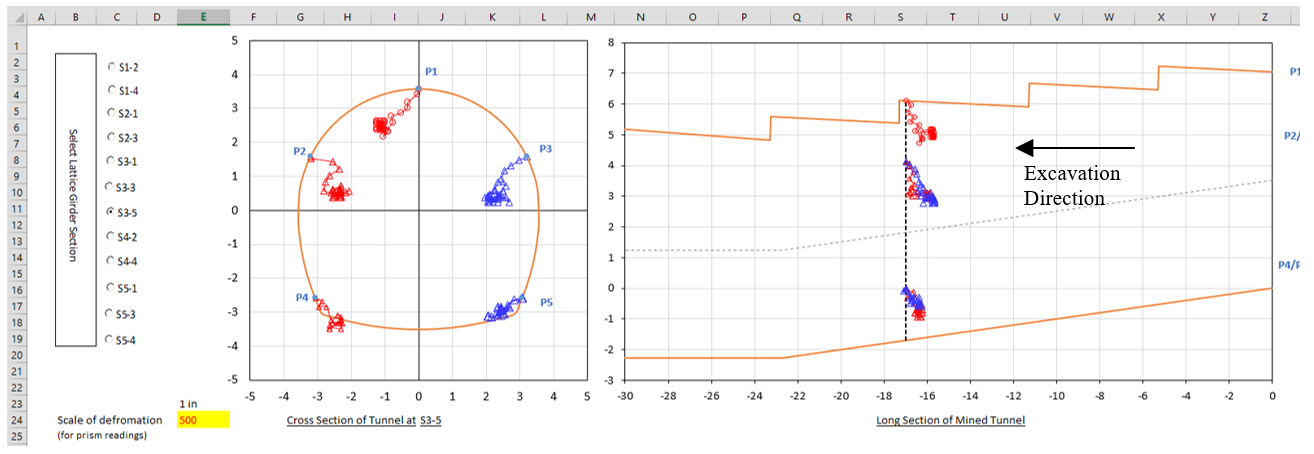
A custom-built spreadsheet macro was prepared for this case study project to visualize the displacement vectors at each monitoring array and deflection curve along the tunnel alignment at any point in time based on the latest raw data obtained from the instrumentation and monitoring contractor. Below figure shows the monitored displacement characteristic of the mined tunnel as vector plot in a plane perpendicular to the tunnel axis. The displacement plot in this figure is for the lattice girder location “S3-5” (which could be selected from the option button on left side. List indicates the location of all monitoring array locations). The displacement pattern can be described as almost symmetrical in the cross section with slightly increased displacement on the right side. In a homogenous, isotropic ground, the crown prism movement is expected to be vertically down however the movement is towards left side which could indicate a possibility of singularities near the face. In case there was any fault / singularities on the right side of the tunnel face, the readings on the right side (instrument P3 and P5) would register larger movements. In this manner, features outside the excavation area (faults, slickensides etc), change in stress situation and kinematics could be predicted based on these displacement vector plots. 

Custom built spreadsheet VB script to visualize displacement vector
Below figure shows the monitored displacements vectors in a plane parallel to the tunnel axis. The plot in longitudinal direction shows displacement vectors tending against the excavation direction. Influence of foliation modifies the longitudinal settlements. Using the knowledge about the influence of the anisotropy orientation on the displacement development, the geological structure encountered on site can be used to predict the expected spatial displacement vector orientation. Any significant deviation from this “normal” behaviour will thus reflect an abnormal behaviour. In case the reason for the abnormality does not originate from a failed support system, the type of deviation can be used to predict changes in the ground condition ahead of the tunnel.

Custom built spreadsheet VB script to visualize 3D prism movements


Ground settlements at different stages of excavation
Monitoring methods along with above interpretation methods could improve short term prediction in tunnelling. The information, which can be extracted from displacement monitoring data, is enormous. This insight plays a crucial role in difficult geotechnical conditions or in sensitive environments. In order to meet the requirements of a Eurocode 7 compliant “observational method” design, dedicated design preparation work prior to construction and organized monitoring system is required. This case study proves that this could be achieved easily on site without the need for any special software. 

Reference:
[1] Senthilnath G T, Mined tunnel monitoring as a part of observational approach - A case study, Tunnelling and Underground Construction Society (Singapore), 2017


Tuesday, 2 May 2017

ITACET Training Course, KL - Lecture on Singapore Case Studies

Recently I had the pleasure to deliver a lecture during ITACET training course in Kuala Lumpur, Malaysia.

Speakers & participants of the ITACET training course

Receiving token of appreciation from Dr. Ooi Teik Aun
The two-day training session on the "Principles of Tunnel Design" was held on 20th & 21st April 2017 at the P J Hilton, Petaling Jaya, Selangor, Malaysia. This short course was organized as a post conference event of the SEACETUS 2017. The training session was organised by The Institution of Engineers, Malaysia (IEM) and the Foundation for Education and Training on Tunnelling and Underground Space Use (ITACET).

The training session provided an introduction to the principles of tunnel design throughout a project cycle, from planning, design and construction, through to implementation of a tunnel or underground project. Contents of the course is available at: link. Official report of the training course is available in IEM wesbite: Link

My presentation was on Case history studies from Singapore. I was able to present case histories from the projects I have been involved in Singapore, which includes:

  • Thomson Line MRT tunnels
  • Power transmission cable tunnels
  • Other LTA projects involving underground linkway construction.
Summary of my presentation brief is available at: link

Friday, 16 December 2016

NCE Tunnelling Awards 2016 - Winner

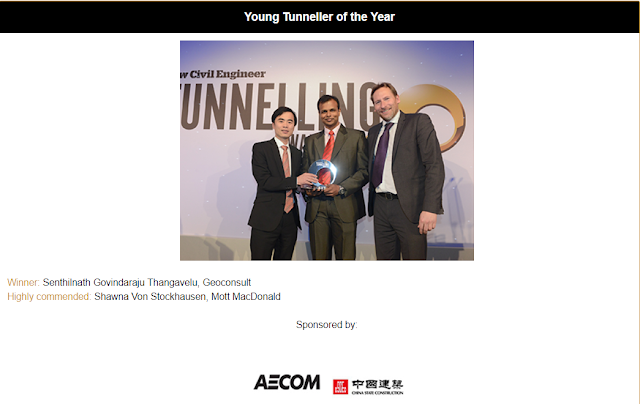
Delighted to be the winner of NCE Tunnelling Awards 2016 under the category "Young Tunneller of the Year".  

This award are given to individuals (with less than 10 years of experience) who has developed experience in the tunnelling industry and has made a notable contribution between Jan '15 and Jul '16. 
Judging criteria was based on:
- Commitment to the tunnelling industry
- Contribution made by the individual to bring innovative ideas or initiatives or lead technically complex design/operations.
- Deliver beyond the client's expectation

Nomination was based on following items: 
- Design and construction support for shotcrete lined (NATM) mined tunnel in soft shallow overburden condition
- Publication in International Journal of Geoengineering Case Histories 2016 (Singapore special issue)
- Contribution in ITACET and local Geotechnical society (GeoSS)

Highlights of the awards event is available below:


Featured in Geoconsult website: Link (link is dead)
Featured in ITACET foundation website: Link
Featured in Tunnel Talk: Link

Thanks to generous support by the tunnelling community worldwide for identifying and encouraging  the young engineers. Who would have imagined, an Indian guy, working for an Austrian firm for Singapore projects would win this honor in United Kingdom! :D

Wednesday, 30 November 2016

Young Professionals Think Deep Programme (YPTDP) 2016 Glasgow (ITACUS-ISOCARP event)

For the first time, ISOCARP in partnership with ITACUS has organized a Young Professional’ Think Deep Program (YPTDP) Workshop. The event was hosted by the City of Glasgow (Glasgow City Council) and took place within the 23rd – 28th of October 2016.The intention of this workshop was to produce a set of case studies contributing towards in-depth analysis of interrelations between city planning focusing on urban design and underground space utilization and infrastructure provision.

The workshop was targeted at junior British and international professionals (up to 35 years old) with various backgrounds such as spatial planning, architecture, civil engineering and real estate management.

There were 20 international participants with various professional backgrounds who attended this workshop. I was fortunate enough to be chosen to represent Singapore at this workshop. The theme chosen for this workshop was "Rethinking the Clyde Waterfront". The focus was on developing strategies for connecting the infrastructure development into underground urban design. This theme strongly connects with the Singapore city planning and I was very hopeful to get maximum out of this workshop.

Participants of YPTDP workshop in Glasgow, Scotland
At a moment when tunnels and underground infrastructure are playing a key role in replacing high-rise infrastructure and surface development to create open green public places, the development of underground space needs to be planned and needs to be seen as an integral part of the city fabric. Many mega-cities are looking at underground space as a last resort, as the spatial relief valve that can for one last time help to free space at the surface rather than planning underground space by choice. In order to create this vision on the use of underground space, this workshop attempted to make planners aware of the subsurface and its role in urban planning as well as to educate engineers the planner's perspective.

The workshop adopted the interactive method, facilitating the search for an "outside the box" approach for an unobvious answers. The group of young planners and engineers coming from 19 countries were asked to support the City of Glasgow with their objective, external view, and with “fresh” ideas for developing the area of the Clyde waterfront. The workshop itself is usually a series of brainstorming exercises, resulting in a vision of development for the area. The style of brainstorming depends on the experience and personality of the participants.

YPTDP Glasgow 2016 - Brainstorming session
My team at YPTDP Glasgow,2016.  Theme: Urban Garden
(from Left: Negar, Senthil, Fillipo, Rosanne, David)
Full report of the workshop and details of the brainstorming session is available at:  https://goo.gl/d1oPGm

Friday, 18 November 2016

ITA Tunnelling Awards Event

ITA Tunnelling awards event took place in Singapore between 10th November and 11th November. Although I was not able to win the title, Singapore had a good share of winning entries.

Singapore won the awards under the following categories:
  • Tunnelling project of the year (between €50 million and €500 million)
  • Safety initiative of the year
  • Innovative use of underground space

Finalists of Young Tunneller of the year 2016 (I am standing 2nd from left)

Finalist Certificate

Colleagues from Geoconsult who came to support my entry during the event

Sunday, 28 August 2016

NCE Tunnelling Awards 2016 - Young Tunneller of the Year (Shortlisted)

New Civil Engineer (NCE) - the official magazine for members of the Institution of Civil Engineers (UK chartered body that oversees the practice of civil engineering in the UK) is organizing Tunnelling Award for the seventh year in 2016. The awards are not only known to showcase the best in tunnelling expertise, most innovative techniques and challenging projects but also has established itself as a premier networking event for the global tunnelling community.

This year, I am delighted to be shortlisted under the category "Young Tunneller of the Year".


List of all finalists could be accessed here.

The shortlist is based on the personal contribution made by the individual to lead major technically complex operations. Following attributes are considered for the shortlist:

  • drive their team, project or business to technical or commercial success
  • deliver beyond the client's expectation
  • personal commitment to improving the tunnelling industry
  • tangible differences made by the environment in which they operate
The shortlisting is done by an esteemed panel of 23 international judges appointed by NCE magazine. Full list of judges is available here. 

#ITAYM #YoungTunneller

Saturday, 20 August 2016

8th Asian Young Geotechnical Engineer's Conference, 2016

Earlier this month, I had the opportunity to represent Geotechnical Society of Singapore (GeoSS) at the Asian Young Geotechnical Engineer's conference (AYGEC). The 25 years tradition of AYGEC started in 1991 with its first conference in Bangkok and now it has reached its 8th edition. 

Along with 2 representatives from Singapore (myself and Ms. Sue Cing from Golder Associates, Singapore office), there were 45 young engineers representing 17 different Asian countries. Apart from young engineers, there were 4 keynote/special lectures by senior professionals/academicians from German Geotechnical Society, Japan Geotechnical society and Korean Geotechnical society. In total there were more than 75 delegates from 24 countries [1]. 

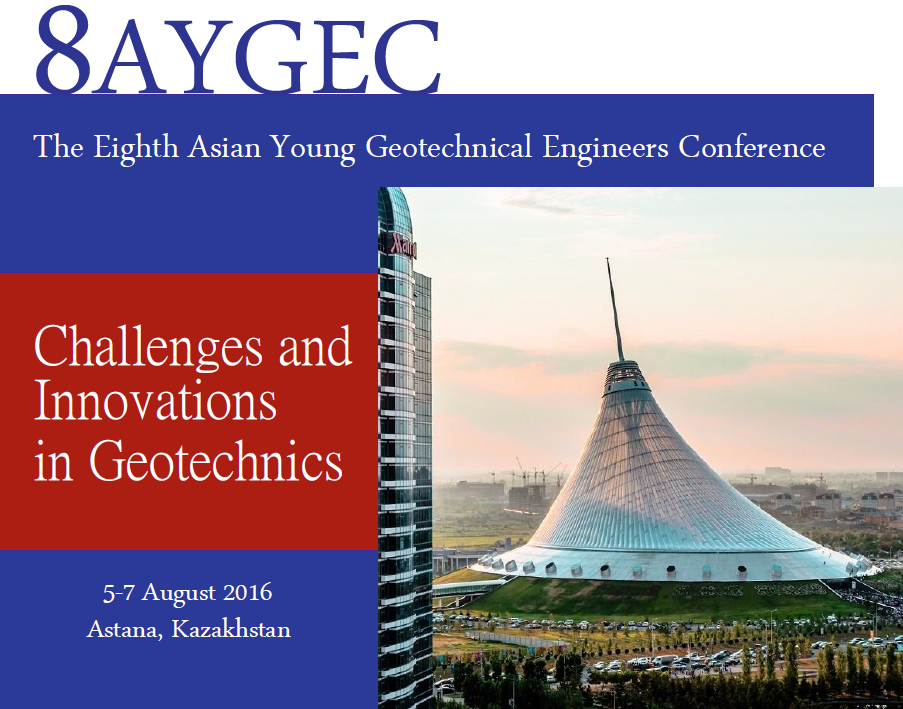
8AYGEC, Astana Kazakhstan

Distribution of participants (17 countries | 29% from industry, remaining from academia)
Two presentations by Singapore representatives were on the topic:
  • Mid-Tunnel underground docking of Tunnel Boring Machines (TBMs) in Singapore - presented by me
  • Two-lane vehicle underpass using pipe roof method at Sentosa Gateway Tunnel - presented by Ms. Sue Cing Teo
The conference theme was aligned with the objectives of ISSMGE Technical Committee - TC305 (Geotechnical Infrastructure for megacities and new capitals). Both the presentations from Singapore were apt for this theme. Our presentations were well received and appreciated by the senior professors from Korea, Japan and Kazakhstan. 

Representatives of GeoSS at 8AYGEC
The venue for the conference was split between Nazarbayev University and Eurasian National University in Astana, Kazakhstan. The conference had one dedicated session on Underground Urban infrastructure. Other sessions of the conference were focused on laboratory and field tests, recent trends in ground improvement, numerical modeling, advanced soil mechanics and geotechnics of historical monuments.

The 2 day conference culminated with field visit on Day 3. The main highlight of the technical visit was the visit to the construction site of EXPO 2017 - a 113 hectares international exposition pavilion. Unfortunately we could not see much of the activities due to weather conditions and safety concerns. 

Artistic view of EXPO 2017 (after completion)
http://geo-technical.blogspot.sg/
EXPO 2017 (in construction)
The collection of peer-reviewed papers presented during this conference are published by CRC Press (Taylor and Francis) Publishers, UK and is available here.


Challenges and Innovations in Geotechnics (ISBN 9781138030077) 

My presentation on Mid-Tunnel TBM Docking


Since all the delegates were of same age group, it resulted in a very lively engagement, discussion and exchange of business cards (and FB handles too) during the networking sessions. The official closure of the conference was eventful with Kazakhstan music and dance. PhD thesis work of Dr. Prashanth Vangla (representative of Indian Geotechnical Society from IISc Bangalore) received the best paper award and Dr. Atsushi Takai (Asst. Professor, Kyoto University, Japan) received the best presenter award. Apart from few hiccups, the conference was very well planned and moderated by Prof. Askar. 

References:
[1] Online article, "The outcome of 8AYGEC" available at: http://www.enu.kz/en/info/news/44808/ (retrieved 20th Aug, 2016)

Friday, 29 July 2016

Shortlisted for ITA Awards

I am very honoured to be shortlisted for the International Tunnelling Associations' ITA Awards (under the category "Young Tunneller of the Year"), in what is considered as the Oscars of the tunnelling industry. A total of 33 finalists (projects and engineers) are selected out of 98 entries from 25 countries in 9 categories. The complete list of finalists is available here. 
ITA Awards Trophy - Bronze bust of Isambard Kingdom Brunel (Sculpted by Sebastien Langloÿs)
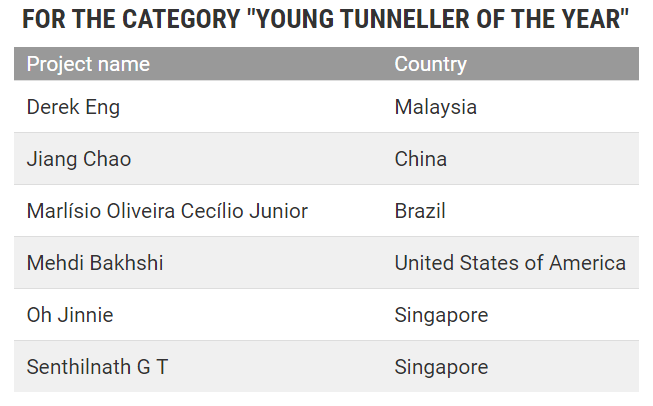
All the finalists for the category "Young tunneller of the year" are shown below (in alphabetical order). Link: https://awards.ita-aites.org/finalists/young-tunneller-of-the-year.html?tmpl=component


Join me for the two-day ceremony (with 8 high profile keynote lectures, finalists presentation and awards ceremony) at the Marina Bay Sands, Singapore


References:
[1] ITA Awards website and newsletter
[2] Tunnel-Online Info website
[3] Tunnel Talk newsletter
[4] Tunnel Builder newsstream
[5] Argentinian tunnelling society newsletter 

Monday, 25 July 2016

Invited Talk on "Impact assessment on existing tunnels due to TBM tunnelling in close proximity"

With the growing population, the need for TBM tunnels in urban environment has continuously increased in the last decade. The need for TBM tunnels is not only limited to urban transportation but is also constantly increasing for other key infrastructure elements, which results in new tunnels constructed close to existing tunnels / other infrastructure. During this presentation, I presented problems/risks associated with tunnels driven in close proximity and how to assess/quantify the impact. A case study was considered to illustrate the impact assessment and risk evaluation.


A copy of the presentation slides could be accessed here. Details of the conference program below.

3rd Annual Underground Space Engineering, Singapore


Wednesday, 8 June 2016

Featured in ITACET newsletter

June issue of ITACET newsletter has featured the abstract of my paper which was shortlisted by Geotechnical Society of Singapore (GeoSS) to be presented at the 8th Asian Young Geotechnical Engineers Conference in Kazakhstan (8AYGEC).


ITACET Newsletter - June edition
The title of the paper is "Mid-tunnel underground docking of Tunnel Boring Machines (TBMs) in Singapore". The paper discusses a case study from Singapore in which, TBMs are docked midway in the tunnel to establish a safe working chamber for concluding construction works (including the TBM dismantling, internal concrete lining etc.) without the need for any intermediate TBM retrieval shaft. 

Picture illustrating docking without a retrieval shaft

Reference:
[1] Senthilnath, G.T., 2016. Mid-tunnel underground docking of tunnel boring machines in Singapore, In The 8th Asian Young Geotechnical Engineering Conference, Astana, Kazakhstan, CRC Press/ Balkema Publishers (accepted, in press)

Tuesday, 17 May 2016

Keynote Presenter in Upcoming conference on Underground Space Engineering, Singapore

Trueventus is organizing the 3rd Annual conference on Underground Space Engineering in Singapore and I am invited as one of the Keynote presenters to present a talk on "Existing tunnel movements due to close proximity". Details of the conference are enclosed below. This post will be updated soon to include the summary of my presentation.


Thursday, 5 May 2016

Underground Space Utilization in Singapore - Part 1


Most of the cities exploit the underground space for dirty and noisy uses like sewer system, transport systems etc. But a few cities have gone a step further and started extensive use of underground space for pedestrian passages, underground storage facilities, shopping mall, office spaces etc. Singapore is one of such cities which is constantly pushing for new innovative use of underground space and already boasts an extensive of use of underground space (see picture below).

Underground space utilization in Singapore
And is further looking for possibilities of creating underground transport hubs, pedestrian links, cycling lanes, utility plants, storage and research facilities, industrial uses, shopping areas and other public spaces. In order to facilitate such projects, Singapore parliament recently amended laws to say that by definition, the state owns underground space more than 30 meters below the surface and the law enabled the state to buy out plots of surface land  so that the ground underneath it can be accessed. These law changes indicate Singapore government's serious foresight about future underground usage plan.

Another school of thought is that it is not just because they need space for people, but it is also because it generates revenue for the economy. Income from land sales alone account to more than US$10 billion for the past few years.

Either way, Singapore is geared to make maximum utilization of its underground space. Now the question is how are the policies developed for such growth? What are the cities that we could look upon for "template"? How Singapore's needs differ from them? I will cover in the next post. 

Sunday, 1 May 2016

New Blog from Politecnico di Torino about Tunnelling Course

I am happy to share that current master student (Mr. Rodrigo Winderholler) of the Tunnelling and TBM master course (10th edition) has started a blog explaining the course details and giving weekly update of the course progress.

It serves as a valuable information to the people who are interested in similar course and gives a basis to someone who wants to assess the course before joining it. I thank Rodrigo in taking the initiative and following the practice that I set during my course period.

I recommend my readers to visit his blog at: http://tunnelling-tbmmaster.blogspot.sg/

New blog on Tunnelling & TBM Master Course - 10th Edition

Tuesday, 26 April 2016

Breakthrough Magazine - Issue 2

This year during the World Tunnel Congress in San Francisco, ITAYM released the second issue of the Breakthrough Magazine. Unfortunately, I couldn't attend this WTC. The magazine could be accessed here.
Breakthrough Magazine - Issue 2
During WTC, there was also an election for ITAYM board members and three new board members (Doris Frank, Slovenia; Giuseppe Maria Gaspari, Italy; Joanne Sui, United Kingdom) were elected to replace the outgoing board members (Nichole Boultbee, Petr Salak and Emily Roguska). Jurij steps down as Chair and Sindre Log is elected as the new Chair for a tenure of two years.
ITAYM Board

Monday, 30 November 2015

Hulme Prize 2015

This year I participated in Hulme Prize competition and my paper was shortlisted in Top 3 for presentation during a TUCSS seminar.

Hulme Prize presentation - invitation flyer

The Hulme Prize was set up by TUCSS in 1999 to honour Terry Hulme, Honorary Member of TUCSS, for his outstanding contribution to TUCSS and Tunnelling in Singapore. It is an annual competition for the best technical papers from young engineers or students (below 35) on any subject related to tunnelling and underground construction.

Hulme Prize paper presentation by Senthil Nath GT

Hulme Prize 2015 presentation in SMRT Auditorium

This paper can be accessed here.

Hulme Prize 2015

Wednesday, 1 July 2015

Breakthrough Magazine - Issue 1

First Issue of Breakthrough magazine was released this year during the ITA General Assemby meeting held during the WTC 2015 in Croatia. The issue could be accessed here.

Breakthrough Magazine - Issue 1
I was also featured in an interview column to talk about my 2nd level masters course at Politecnico di Torino, Italy.
Interview column