Showing posts with label SiteVisit. Show all posts

Saturday, 20 August 2016

8th Asian Young Geotechnical Engineer's Conference, 2016

Earlier this month, I had the opportunity to represent Geotechnical Society of Singapore (GeoSS) at the Asian Young Geotechnical Engineer's conference (AYGEC). The 25 years tradition of AYGEC started in 1991 with its first conference in Bangkok and now it has reached its 8th edition. 

Along with 2 representatives from Singapore (myself and Ms. Sue Cing from Golder Associates, Singapore office), there were 45 young engineers representing 17 different Asian countries. Apart from young engineers, there were 4 keynote/special lectures by senior professionals/academicians from German Geotechnical Society, Japan Geotechnical society and Korean Geotechnical society. In total there were more than 75 delegates from 24 countries [1]. 
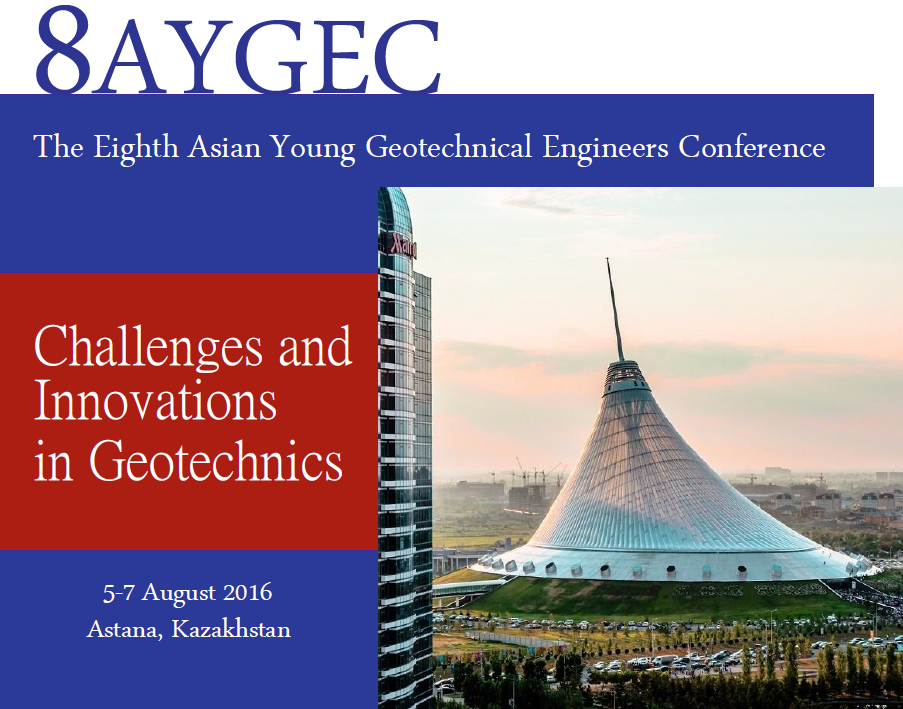
8AYGEC, Astana Kazakhstan

Distribution of participants (17 countries | 29% from industry, remaining from academia)
Two presentations by Singapore representatives were on the topic:
  • Mid-Tunnel underground docking of Tunnel Boring Machines (TBMs) in Singapore - presented by me
  • Two-lane vehicle underpass using pipe roof method at Sentosa Gateway Tunnel - presented by Ms. Sue Cing Teo
The conference theme was aligned with the objectives of ISSMGE Technical Committee - TC305 (Geotechnical Infrastructure for megacities and new capitals). Both the presentations from Singapore were apt for this theme. Our presentations were well received and appreciated by the senior professors from Korea, Japan and Kazakhstan. 

Representatives of GeoSS at 8AYGEC
The venue for the conference was split between Nazarbayev University and Eurasian National University in Astana, Kazakhstan. The conference had one dedicated session on Underground Urban infrastructure. Other sessions of the conference were focused on laboratory and field tests, recent trends in ground improvement, numerical modeling, advanced soil mechanics and geotechnics of historical monuments.

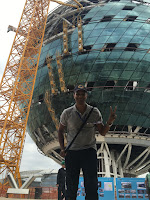
The 2 day conference culminated with field visit on Day 3. The main highlight of the technical visit was the visit to the construction site of EXPO 2017 - a 113 hectares international exposition pavilion. Unfortunately we could not see much of the activities due to weather conditions and safety concerns. 

Artistic view of EXPO 2017 (after completion)
http://geo-technical.blogspot.sg/
EXPO 2017 (in construction)
The collection of peer-reviewed papers presented during this conference are published by CRC Press (Taylor and Francis) Publishers, UK and is available here.


Challenges and Innovations in Geotechnics (ISBN 9781138030077) 

My presentation on Mid-Tunnel TBM Docking


Since all the delegates were of same age group, it resulted in a very lively engagement, discussion and exchange of business cards (and FB handles too) during the networking sessions. The official closure of the conference was eventful with Kazakhstan music and dance. PhD thesis work of Dr. Prashanth Vangla (representative of Indian Geotechnical Society from IISc Bangalore) received the best paper award and Dr. Atsushi Takai (Asst. Professor, Kyoto University, Japan) received the best presenter award. Apart from few hiccups, the conference was very well planned and moderated by Prof. Askar. 

References:
[1] Online article, "The outcome of 8AYGEC" available at: http://www.enu.kz/en/info/news/44808/ (retrieved 20th Aug, 2016)

Sunday, 6 July 2014

Ceneri Base Tunnel Visit - Week 24

During the Week 24 (30th June - 4th July) of our Tunnelling course, we had a visit to the Herrenknecht HQ and a visit to the Switzerland's third largest tunnel - Ceneri Base Tunnel. This blog post presents some of the details of the latter.

Ceneri Base Tunnel © AlpTransit Gotthard Ltd. Retrieved 4th July '14
The 15.4 km Ceneri Base Tunnel completes the link between Zurich and Milan (passing through the Gotthard Base Tunnel) with overburden varying from 800m to 100m. The project is managed by Alptransit Gotthard Ltd and the contractor is Condotte Cossi Consortium.

Location of Ceneri Base Tunnel [1]
Based on the Pini Swiss Engineer's presentation (during Week 18 of our course), we had an overview of the project's technical and geological challenges. Our visit was more focussed to learn the operational and logistical challenges and how innovatively, the Alptransit has been managing it. This tunnel construction site, probably, has the most mechanized form of Drill and Blast tunnelling.

The tunnel face
The tunnel face can be seen in the picture above. There is no problem in the stability of face and hence no additional measures are taken. The support system can be seen - rockbolts with shotcrete. No steel arches are used. Second layer of shotcreting is done after installing the rockbolts.

Three boom drilling jumbo (suspended logistic platform can be seen at crown)
Crusher at the starting of belt conveyor.
The tunnel is excavated using Drill and Blast technique. Two drilling jumbos are available at the site. One of them is used for tunnel advancing and the other one is used for cross tunnels. After each round of blasting, the muck is loaded in to the crusher using a back hoe loader. The crusher is connected to the belt conveyor and the muck is taken away to the portal. The whole system of belt conveyor and ventilation is hanging from the crown using a logistic platform and could be extended as the tunnel advances (like in a TBM).

One of its kind - Concrete batching plant inside the tunnel (special cavern)
Special cavern is built to accommodate the batching plant inside the tunnel itself.
Provision for future expansion
Complete muck handling system is using belt conveyor.
Nonel detonators
Sliding form work for Tunnel side walls in preparation
Sliding formwork for the tunnel side wall can be seen in the above picture. This is at a cavern location. The complete crown is going to be concreted using shotcrete (no formwork is used at cavern's crown). Lattice girder type assembly is used in steel cage work to optimise the rebar cage assembly time.


References:
[1] European International Contractors (EIC) newsletter (link), retrieved on July 5th, 2014.

Friday, 4 July 2014

Herrenknecht Visit - Schwanau, Germany

Towards the end of our MAS degree program on Tunnelling and TBM at Politecnico di Torino, we had an opportunity to visit the Herrenknecht's main manufacturing facility in Schwanau, Germany. Politecnico di Torino (Prof. Daniele Peila) along with the Herrenknecht's engineers organised this visit for the participants of the MAS program.
Herrenknecht EPB TBM for Doha Metro - Assembled at Schwanau, Germany
I have been working as a Geotechnical engineer from the year 2009 and during this period of 5 years, I was lucky enough to visit and get involved in some very interesting construction sites (ranging from mining sites, underground metro, harbour facilities, skyscrapers, power plants, railways etc) but I was never as much excited as I was during the visit to the Herrenknecht's headquarters. Although this is technically not a construction site, the Tunnel Boring Machines (TBMs), manufactured here, plays a pivotal role in the success of any Tunnelling construction site and the amount of "Civil engineering concepts" goes into making of this "Mechanical machine" is immense. It was not just me, most of the course participants felt the same way. It was the Disney Land of the Tunnel/Geotech engineer or of that sort, one can not get upset here.

We had an opportunity to visit EPB TBM, Mix-Shield (Slurry) TBM, EPB-Hard Rock Convertible TBM and Hard Rock Gripper TBM in the bigger diameters suite. In addition to the assembled TBMs, we witnessed and learned, among others, the following important aspects:
  • The process of assembly of main bearing
  • Segment erection process
  • Mechanism of foam delivery for soil conditioning
  • Working of screw conveyor
  • Slurry separation unit
On the Microtunnelling front, we saw completely assembled and spare parts of Pipe jacking Micro TBMs (EPB and Slurry), Pipe thrusters and HDD rig. This visit, coming just after Prof. Sterling's lecture on Microtunnelling gave us a comprehensive understanding on the mechanism of Microtunnels and working phenomenon.
Herrenknecht - Main facility entrance