During the Week 24 (30th June - 4th July) of our Tunnelling course, we had a visit to the Herrenknecht HQ and a visit to the Switzerland's third largest tunnel - Ceneri Base Tunnel. This blog post presents some of the details of the latter.
The 15.4 km Ceneri Base Tunnel completes the link between Zurich and Milan (passing through the Gotthard Base Tunnel) with overburden varying from 800m to 100m. The project is managed by Alptransit Gotthard Ltd and the contractor is Condotte Cossi Consortium.
Location of Ceneri Base Tunnel [1]
Based on the Pini Swiss Engineer's presentation (during Week 18 of our course), we had an overview of the project's technical and geological challenges. Our visit was more focussed to learn the operational and logistical challenges and how innovatively, the Alptransit has been managing it. This tunnel construction site, probably, has the most mechanized form of Drill and Blast tunnelling.
The tunnel face
The tunnel face can be seen in the picture above. There is no problem in the stability of face and hence no additional measures are taken. The support system can be seen - rockbolts with shotcrete. No steel arches are used. Second layer of shotcreting is done after installing the rockbolts.
Three boom drilling jumbo (suspended logistic platform can be seen at crown)
Crusher at the starting of belt conveyor.
The tunnel is excavated using Drill and Blast technique. Two drilling jumbos are available at the site. One of them is used for tunnel advancing and the other one is used for cross tunnels. After each round of blasting, the muck is loaded in to the crusher using a back hoe loader. The crusher is connected to the belt conveyor and the muck is taken away to the portal. The whole system of belt conveyor and ventilation is hanging from the crown using a logistic platform and could be extended as the tunnel advances (like in a TBM).
One of its kind - Concrete batching plant inside the tunnel (special cavern)
Special cavern is built to accommodate the batching plant inside the tunnel itself.
Provision for future expansion
Complete muck handling system is using belt conveyor.
Nonel detonators
Sliding form work for Tunnel side walls in preparation
Sliding formwork for the tunnel side wall can be seen in the above picture. This is at a cavern location. The complete crown is going to be concreted using shotcrete (no formwork is used at cavern's crown). Lattice girder type assembly is used in steel cage work to optimise the rebar cage assembly time.
References:
[1] European International Contractors (EIC) newsletter (link), retrieved on July 5th, 2014.
During the Week 23 (23rd June to 27th June) of our MAS course on Tunnelling and TBM, we had a special lecture by Dr. Ray Sterling, P.E. (Professor Emeritus at Louisiana Tech University) on Microtunnelling and Trenchless Technology.
Prof. Sterling's lecture gave an overview of the different trenchless technologies available (displacement methods, HDD, Pipe jacking & Hybrid methods). The three day lecture series was focussed on:
Suitability and advantages of various trenchless methods
Estimation of jacking loads and ground loss during microtunnelling
Estimation of Direct, Indirect and Social cost of a typical trenchless project
Prof. Ray Sterling's Lecture on Trenchless Technology and Microtunnelling
Prof. Sterling also presented two case studies on the use of trenchless technology for installation of Sewer system in Berlin [5] and experience in Europipe project [6].
References:
[1] Stein, D., 2005. Trenchless Technology for the Installation of Cables and Pipelines, Ernst and Sohn, Germany.
[2] Bennett, D., 1998. Jacking Loads and Ground Deformations Associated with Microtunneling, Ph.D. Thesis, University of Illinois at Urbana-Champaign.
[3] Milligan, G. W. E., and C. D. F. Rogers. "Chapter 19: Trenchless technology." Geotechnical and Geoenvironmental Engineering Handbook. Springer US, 2001. 569-592.
[4] Microtunneling and Horizontal Drilling, Recommendations by French Society for Trenchless Technology, Hermes Science Publishing Ltd, 2004
[5] Mohring, K. "Berlin- capital city of microtunnelling." No-Dig International 4.5 (1993): 5-6.
[6] Lauritzsen, R., O. K. Sande, and A. Slatten. "Europipe landfall tunnel." Publikasjon-Norges Geotekniske Institutt 197 (1996): G2-1.
As in any construction site, underground worksites poses many dangers. In addition to the general hazards typical to any worksite, there are some specific hazards particular to underground worksite. To cover these aspects, Week 22 (16th June to 20th June) lectures were focussed on Health and Safety of Worksite and Equipments. Mr. Achille Sorlini from Geodata and Prof. Mario Patrucco from Politecnico di Torino gave us an overview of the topic with some case studies and engineering design control methods.
Examples of specific measures to be taken in case of following typical events were discussed:
Event of fire
Event of gas in-leakage
Event of water inrush
Event of cave-in / rock burst
Compressed air interventions
Major Tunnelling safety codes [1-6] of practices were discussed. ITA Working Group on Health and Safety in Works [3] gives a brief summary of important aspects to be covered while preparing HSP (Health and Safety Plan) for a Tunnelling site and serves as a quick reference. TBG Handbook prepared by ITA [4] gives an illustrative examples of safe and un-safe practices, particularly very useful for Tunnel workers and first line supervision.
Example of safe practices given in TBG handbook [4]
References:
[1] British Standard 6164 Code of practice for safety in tunnelling in the construction Industry,2001.
[2] DAUB Recommendations for Planning and Implementation of Occupational Health and Safety concepts in Underground Worksites, 2007.
[3] ITA WG: Health and Safety in Works - Guidelines for Good Occupational Health and Safety Practice in Tunnel Construction, November 2008
[4] ITA WG: Health and Safety in Works - Safe Working in Tunnelling TBG Handbook
[5] European Standard EN 12336: Tunnelling machines - Shield machines, thrust boring machines, auger boring machines, lining erection equipment - Safety requirements, 2005.
[6] Council Directive 92/57/EEC on the implementation of minimum safety and health requirements at temporary or mobile construction sites
[7] OSHA 29 CFR, Safety and Health Regulations for Construction - Underground Construction, Caissons, Cofferdams and Compressed Air (1926.800), US Department of Labor.
[8] OSHA 3115, Underground Construction (Tunnelling), US Department of Labor.
[9] European Standard EN 815: Unshielded tunnel boring machines and rodless shaft boring machines for hard rock - safety requirements
[10] European Standard EN 12111: Tunnelling machines - Boring machines, continuous miners and impact rippers - safety requirements
[11] European Standard EN 12110: Tunnelling machines - pressure zone access - Safety requirements.
Week 20 and 21 (2nd June to 13th June) of the specializing course on Tunnelling and TBM covered the design aspects of the following Auxiliary Tunnel Facilities:
Underground Railway Transportation (Rails, Rolling stock and Locomotives)
Underground Ventilation System [1] [3]
Conveyor Belts
Compressed Air
Separation Plant for Slurry Shield [2]
Water Treatment Plant [2]
Lighting [1]
Above design aspects were discussed by the designers from the leading industry suppliers (Atlas Copco, Swedvent, Marti Technik) and contractors (Salini Impregilo).
Mr. Marco Arato from Atlas Copco - Lecture on Locomotives and Ventilation
Mr. Antonio Nicola - Overview lecture on Auxiliary Tunnel Facilities
Prof. Oggeri (also the Animateur of WG 16 : Quality in Tunnelling), discussed about the recommendations on how to achieve Quality in Tunnelling and how to identify, evaluate and specify Quality Management measures to be taken by all parties in the Conceptual Planning, Procurement, Design, Construction, Operation and Maintenance phases of underground projects involving tunnels [4]. References:
[1] Kolymbas, Dimitrios. "Chapter 2: Installations in tunnels." Tunnelling and Tunnel Mechanics: A Rational Approach to Tunnelling (2005): 31-56.
[2] Maidl, Bernhard, Markus Thewes, and Ulrich Maidl. "Chapter 8: Ventilation During the Construction Phase." Handbook of Tunnel Engineering I, First Edition (2013): 409-425.
[3] Swiss SIA Standard 196, Underground Ventilation (edition 1998), Swiss Engineers and Architects Association.
[4] Oggeri, Claudio, and Gunnar Ova. "Quality in tunnelling: ITA-AITES working group 16 final report." Tunnelling and underground space technology 19.3 (2004): 239-272.
[5] Wood, Alan Muir. Tunnelling: management by design. CRC Press, 2002.
[6] American Association of State Highway and Transportation Officials. Best Practices for Implementing Quality Control & Quality Assurance for Tunnel Inspection. AASHTO T-20, 2009.
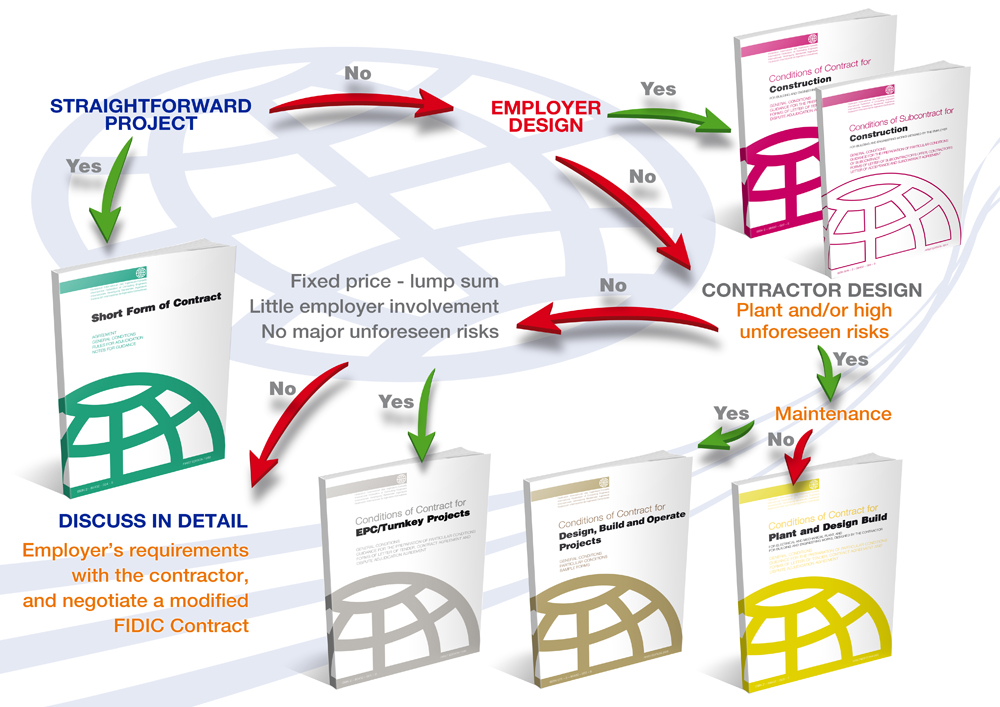
During the specialising course on Tunnelling and TBM at Politecnico di Torino, we had a module on Contracts and Claims. Understanding contractual nuances plays a very important role in managing complex projects such as Tunnelling, which is prone to a lot of claims. Only a keen and comprehensive understanding of the contracts will help in avoiding disputes and accompanying cost and time overruns. Mr. Romano Allione, Chairman of Dispute Resolution Board Foundation, took us through the clauses of the FIDIC, Red Book (Conditions of contract for construction) and briefly introduced the other forms of Contracts (Short form, EPC-Turnkey, Plant, Design and Build). Emphasis was made on Clause 20 (Claims, Disputes and Arbitration) and the timeline to be followed as per FIDIC form of contract.
Different forms of FIDIC Contract
Following the above lecture, Mr. Patrizio Torta from PM&E s.r.l gave us an overview of claims, calculation of claims under different scenarios with case studies.
References:
[1] Bunni, Nael G. The FIDIC form of contract: the fourth edition of the Red Book. Oxford: Blackwell Science, 1997.
[2] Glover, Jeremy, and Simon Hughes. Understanding the FIDIC Red Book: A Clause by Clause Commentary. Sweet & Maxwell, 2011.
[3] Jaeger, Axel Volkmar, and Götz-Sebastian Hök. FIDIC: A guide for practitioners. Springer, 2009.
[4] Perry, John G. "The New Engineering Contract: principles of design and risk allocation." Engineering, Construction and Architectural Management 2.3 (1995): 197-208.
[News: I would like to thank all subscribers of my blog. Last month I reached total page views of more than 10,000! That is a lot more than I anticipated. Thanks for encouraging, following and sharing with fellow tunnelling engineers.]
Week 19 (26th May to 29th May) covered the details about the Segmental Lining design. This is the third week of classes on Segmental lining and related issues (previous posts: Week 18and Week 16). Mr. Michele Mangione from Arup, UK took us through the Design Methodologies and case studies on Segmental opening support systems.
Mr. Michele Mangione's Lecture on Segmental Lining Design
The general approach of segmental lining design could be briefly summarized as:
1. Determine the level of loading
2. Design Model
Analytical Model (Continuum model - Muir Wood / Curtis or Bedded beam model - Duddeck and Erdmann)
FEM analysis
3. Compute Normal forces, Shear Forces, Bending Moment and Deflection
4. Design for above member forces
5. Additional design and checks for following conditions:
Thrust jacking loads
Secondary grouting loads,
Storage and lifting loads
Birds-mouthing of radial joints
Flowchart for Tunnel Lining Design
One of the problems often faced by young Tunnel designers is the lack of a single reference (a Textbook/ Guideline) for all design approaches required during segmental lining design. I have made an attempt to review the following guidelines/recommendations and summarize the concepts covered in each reference.
DAUB recommendations [5] summarizes the design principles very briefly (including fire loads and steel fibers) and serves to be a handy reference. It does not include any example design calculations.
ITA-WG No. 2's guidelines on Tunnel lining design [6] is another very useful reference for Tunnel designers. The guideline presents the basic concepts yet in detailed way with examples and references. However, it does not cover the concepts like Fire loads and steel fiber segmental linings.
British Tunneling Society's Tunnel lining design guide [12] is a comprehensive document for general design philosophy of tunnels. Chapter 5 and 6 summarize the design aspects related to Segmental Lining design. The guideline does not include the details of structural design and does not have examples but has a detailed list of references for further study. The guideline however presents a case history on Channel Tunnel and Great Belt Lining design.
Singapore, Land Transport Authority - Guideline for Tunnel Lining Design (Part 1) [9] covers the design guidelines for Segmental Lining. This brief document clearly summarizes the loads, load combinations, typical K values for different soils and numerical models to be considered for the lining design. It also includes a detailed set of example design.
AFTES (French recommendation) [3] for segmental lining design covers full range of the areas affecting the design and construction of precast concrete segments. This guideline discusses in detail about composition of rings in different types of rings (rectangular, trapezoidal and parallelogrammic segments), contact joints and gaskets. Section 4 of the guideline presents various load combination for design of segments in Serviceable and Ultimate limit states. The unique feature of this guideline is, it presents a table indicating sensitivity/importance of various parameters for different stages of project and for different methods of analysis.
In a future post, I intend to discuss the different design models and share a spreadsheet to quickly estimate (for pre-dimensioning purposes) the member forces using different design models.
Post class hangout with Mr. Michele Mangione, Arup UK
References:
[1] T. R. Kuesel, E. H. King, and J. O. Bickel, Tunnel Engineering Handbook. London: Springer, 2011, p. 528.
[2] FHWA (US), and Parsons, Technical Manual for Design and Construction of Road Tunnels--civil Elements. AASHTO, 2010.
[3] AFTES, “The design, sizing and construction of precast concrete segments installed at the rear of a tunnel boring machine (TBM),” 2005.
[4] A. M. Wood, Tunnelling: management by design. CRC Press, 2002.
[5] DAUB, “Recommendations for the Design , Production and Installation of Segmental Rings,” pp. 1–56, 2013.
[6] ITA working group on general approaches to the design of tunnels, “Guidelines for the Design of Shield Tunnel Lining,” Tunn. Undergr. Sp. Technol., vol. 15, no. 3, pp. 303–331, 2000.
[7] ITA working group on general approaches to the design of tunnels and F. Report, “Guidelines for the design of tunnels☆,” Tunn. Undergr. Sp. Technol., vol. 3, no. 3, pp. 237–249, 1988.
[8] H. Duddeck, “Future trends in the structural design of tunnels,” Tunn. Undergr. Sp. Technol., vol. 2, no. 2, pp. 137–141, 1987.
[9] J. Poh and G. K. Hun, “Guidelines for Tunnel Lining Design,” Singapore, 2006.
[10] H. Duddeck and J. Erdmann, “Structural design models for tunnels: Tunnelling 82, proceedings of the 3rd international symposium, Brighton, 7--11 June 1982, P83--91. Publ London: IMM, 1982,” Int. J. Rock Mech. Min. Sci. Geomech. Abstr., vol. 20, no. 1, p. A15, 1983.
[11] A. M Wood, “The circular tunnel in elastic ground,” Geotechnique, vol. 25, no. 1, pp. 115–127, 1975.
[12] The British Tunnelling Society, “Tunnel lining design guide,” Thomas Telford, London, 2004.
Last lecture of Week 17 and most of the lectures during Week 18 (16th May to 23rd May) were focused on Ground Settlements, influence of TBM drive on surface buildings and on Segmental lining.
Prof. Stefano Invernizzi, explained the different available models for predictions of greenfield ground movements. Pickhaver [1] has briefly summarized all the semi-emperical, empirical methods and numerical methods in his PhD thesis. Detailed version can be studied in Geodata's book on Mechanized Tunnelling [2]. (related post which I came across recently: Interesting article about empirical estimation and numerical estimation).
Prof. Fritz Gruebl (University of Stuttgart, Germany) and Dr. Davorin Kolic (ITA-Croatia President) gave us an account TBM drive overview (including logistics, ventilation and emergency systems) with an emphasis on Tunnel Induced settlements and Universal Segmental Lining.
Models to explain the possibilities of different curve radius using Universal Segments
Prof. Fritz Gruebl's Lecture on TBM Drive & Segmental Lining
On 22nd May, we had detailed case study analysis of Ceneri Tunnel with the designers from Pini Swiss Engineers, Switzerland. Mr. Davide Merlini, Mr. Francesco Rossi and Mr. Stefano Morandi gave us an overview of the Ceneri Base Tunnel from a designer perspective (from the project conception stage to the construction stage).
Case Study on Ceneri Base Tunnel by Pini Swiss Engineers
On 23rd May, (as explained in an earlier post) we has another case study analysis from a Contractor's perspective.
References:
[1] J. A. Pickhaver, “Numerical Modelling of Building Response to Tunnelling,” University of Oxford, 2006.
[2] V. Guglielmetti, P. Grasso, A. Mahtab, and S. Xu, Mechanized tunnelling in urban areas: design methodology and construction control. CRC Press, 2008.
This is a weekly update after a really long time. Week 14 & 15 was off because of Easter Vacations. Along with lot of catching up with the course work, I also had a chance to visit some places in Italy :) (some of the photos are shared here)
Week 16 (May 5th to 9th) of the Tunnelling & TBM course was dedicated for understanding the concepts and design steps related to Segmental Lining design for Tunnels excavated using TBM. With the background on Lining design for SEM/NATM construction (Week 6 of this course), this week, Mr. Moreno Pescara (Technical Director from Geodata) gave us an overview of Universal rings, gaskets, design steps and precautions to be taken as a Tunnel designer. We also had a Guest Lecturer from Turin public transport authority who gave us a design case study on Torino Metro.
This was Part 1 of lecture on Segmental Lining, more details on the segmental lining and case studies are expected to be covered in the future weeks (Week 18-19). Keep looking for Segmental Lining Design (Part 2) for summary of the lessons, references and spreadsheets.
Last 2 weeks of lecture (7th to 16th April, 2014) was mainly focussed to give us an overview of types of TBM and selection of TBM according to the project and geologic requirements.
Along with the theoretical background, to give us a practical understanding of TBM type selection and design, we had the following guest lectures from the Industry:
Slurry shield TBM by Prof. Markus Thewes, Institute for Tunnelling and Construction Management, Ruhr-University Bochum
Rock TBMs by Mr. Massimo Concilia, Project Manager, Impresa Pizzarotti & C. S.p.A.
EPB and Hydro-Shield by Mr. Allesandro Cresdo, Manager, Herrenknecht
TBM Selection case histories by Mr. Jens Classen, Director of Mechanized Tunnelling, TOTO
TBM Selection case histories by Gilbert Fontanille, NFM Technologies
Design of TBM by Maurizio Marchionni, Geodata.
In the next blog post, various guidelines for the selection of TBM and key design aspects of TBM are discussed.
Mr. Allesandro Cresto's Lecture on EPB and Hydro-Shield
Along with general aspects of TBM Types and TBM selection, on 4th April, 2014 we had a guest lecture from Singapore (Mr. Richard Schulkins) to deliver a lecture on the topic of Soil Conditioning for EPB Tunnelling.
EPB Tunnelling has experienced a great increase in the number of applications and it can be considered the most used technology of the mechanised tunneling in urban area [3,7]. In this lecture, Mr. Schulkins discussed the objectives of Soil conditioning in EPB Tunnelling and the procedure for soil conditioning using various additives.
Click here for a basic presentation on Soil Conditioning by Prof. Peila (ITACET lecture presented in Argentina).
Followed by the lecture, we had a chance to see the experimental setup and witness some tests. Tests on characterisation of conditioned soil is limited and only recently some large scale tests using laboratory screw conveyor has been proposed [5] (details of past studies and tests are included in this reference) and Politecnico di Torino has one of such facilities to test the conditioned soil [1,3,7].
Experimental Setup in Politecnico di Torino [3]
There are five established tests for optimizing the conditioned soil (Foam penetration test, Slump test, shearing test, Compressibility test and friction test) however, during this lab demonstration, quality assessment of the conditioned soil were tested using slump cone test and permeability test. More details about the experimental setup and the test to assess the behaviour of conditioned soil is covered in the paper Peila et al (2009) [2]. Following video shows the demonstration in the Department of Structural Engineering, Construction and Geotechnical, Politecnico di Torino, Italy.
Following video shows the permeability test on the conditioned soil with 10m constant water head. The details of the setup and the test results could be studied in the paper Borio et al (2010) [4].
References:
[1] D. Peila, C. Oggeri, and R. Vinai, “Screw conveyor device for laboratory tests on conditioned soil for EPB tunneling operations,” J. Geotech. Geoenvironmental Eng., vol. 133, no. 12, pp. 1622–1625, 2007.
[2] D. Peila, C. Oggeri, and L. Borio, “Using the slump test to assess the behavior of conditioned soil for EPB tunneling,” Environ. Eng. Geosci., vol. 15, no. 3, pp. 167–174, 2009.
[3] R. Vinai, C. Oggeri, and D. Peila, “Soil conditioning of sand for EPB applications: A laboratory research,” Tunn. Undergr. Sp. Technol., vol. 23, no. 3, pp. 308–317, May 2008.
[4] L. Borio and D. Peila, “Study of the Permeability of Foam Conditioned Soils with Laboratory Tests.,” Am. J. Environ. Sci., vol. 6, no. 4, pp. 365–370, 2010.
[5] L. Borio, D. Peila, C. Oggeri, and S. Pelizza, “Characterization of soil conditioning for mechanized tunnelling .”
[6] Pena. A, “Foam as a soil conditioner in tunnelling : physical and mechanical properties of conditioned sands,” University of Oxford, 2007.
[7] R. Vinai, D. Peila, C. Oggeri, and S. Pelizza, “Laboratory tests for EPB tunnelling soil conditioning,” in Underground Space - the 4th Dimension of Metropolises, 2007, pp. 273–278.
Week 10 (24th March to 28th March '14) Lecture series of Tunnelling and TBM course marks the begining of Module 2 of the course, which is focused on Mechanized Tunnelling using TBM. This week's lecture was also combined with the ITACET Training Seminar which was open for working professionals also.
Week 10's lecture along with Today's (1st April '14) lecture by Professor Peila gives a complete overview of Mechanized Tunnelling using TBM (more details in the links below).
Following lectures were covered during this week:
1st April, 2014: General Aspects of TBM by Prof. Daniele Peila, Politecnico di Torino
Week 9 (17th March to 21st March) of the Tunnelling and TBM course in
Politecnico di Torino was completely dedicated to the Numerical Modelling
(basics and practical example in commercially available softwares). We had a
chance to simulate Tunnel excavation sequence in Phase2 software and
compare results with Plaxis Software. Ms. Vincenza Floria from Geodata assisted
us in Numerical modelling and clarified our practical difficulties. I intend to blog more about the numerical analysis and software comparisons (Plaxis with Phase2)in coming weeks.
Eg. Simulation of Tunnel excavation sequence in Urban Environment
Week
8 (10th March to 14th March) of the Tunnelling and TBM course was dedicated to Ground Reinforcement using
Jet Grouting and Steel Pipe Umbrella. Prof. Peila explained us the recent trends and
the commonly used methods for the design of Steel Pipe Umbrella as Tunnel Supporting
structure.
Two main design approaches of Steel Pipe Umbrella were discussed:
1. Equivalent 2D model by considering each Steel Pipe individually deducing bending moment and reaction forces (as shown below):
More on this topic to be discussed in future blogs.
2. 2D Numerical Model, by considering an area of improved Geomechanical properties. This topic is discussed in Hoek's 2000 Terzaghi Lecture (more details here)
3. 3D Model by modelling individual elements in rockmass.
During
this week, we also had an opportunity of hands-on experience with the Rock
testing, Prof. Peila organized a visit to Rock Mechanics Laboratory in
Politecnico di Torino.
Shear Test on Discontinuities
High Pressure Triaxial Apparatus (HPTA)
Triaxial Apparatus for Gravels
Geothermal Model
References:
[1] Oreste, P. P., and D. Peila. "A new theory for steel pipe umbrella design in tunneling." Tunnels and Metropolis. Proceedings of The World Tunnel Congress on Tunnels and Metropolises. Vol. 2. 1998.
[2] Pelizza, Sebastiano, and Daniele Peila. "Soil and rock reinforcements in tunnelling." Tunnelling and underground space technology 8.3 (1993): 357-372.
[3] Peila, D., and S. Pelizza. "Ground reinforcing for tunnelling the example of Steel pipe umbrella." AITES-ITA Training Course Tunnel Engineering. Istanbul, Turkish (2005).
[4] E. Hoek, “Big Tunnels in Bad Rock - 2000 Terzaghi Lecture,” ASCE J. Geotech. Geoenvironmental Eng., vol. 127, no. 9, pp. 726–740, 2001. (PDF is shared in Hoek's corner, here)
Week 7 (3rd Mar '14 to 7th Mar '14) of 2nd Level specializing course in Tunnelling and TBM started with a lecture by Prof. Galler on NATM technique (details here). Followed by lectures on Geotechnical Monitoring, Ground Reinforcement and Lining Segments.
Prof. C. Oggeri explained us about the concepts and importance of Ground monitoring with case studies. Ground response monitoring forms a key aspect of Observational Method / NATM Technique.
Observational Design Cycle
For further reading on Ground Monitoring, we referred to the book by Dunnicliff [1]. In the latter part of the week, we were given the basic concepts of Ground Reinforcements and Ground Improvement for Tunnelling applications, detailed discussion to follow in Week 8.
References:
[1] Dunnicliff, John. "Geotechnical instrumentation for monitoring field performance." (1993).
Week 6 (24th Feb '14 to 28th Feb '14) of 2nd Level specializing course in Tunnelling and TBM was on Shotcrete and Design of lining, including the use of support interaction capacity curves. Majority of this week's time was spent on understanding the evolution of design philosophy for tunnel liners using shotcrete and steel-sets.
Initial Support & Lining System Used in Current Practice [1]
It is understood from the above figure that the application of Shotcrete + Steelsets is used for wide range of ground conditions and is one of the most widely used support system.
Concepts of three main design methods: Distributed ground pressure approach, subgrade reaction approach and Ground-support interaction approach were discussed. The paper on composite supports (Steel-sets + Shotcrete) by Hoek's research group (Carranza-Torres et al) [2] was helpful in understanding the concepts of Capacity diagrams.
Other paper which was reviewed during this week was Oreste (2007) which is on Hyperstatic reaction (numerical method) to simulate interaction between the support and rock surroundings using springs. Based on several calculation using Hyperstatic Reaction Method (HRM), design tables are presented for dimensioning support system (with Steel-sets + Shotcrete).
For complete understanding of shotcrete usage and admixtures used, we had invited lectures by Mr. Enroco Dal Negro, Carlo Pistolesi and Cristiano Maltese (from Maipei) on practical aspects of shotcrete use in a site and on Concrete Technology.
Also during this week, we had a special lecture by Mr. Juha Kukkonen (from Sandvik) on Drilling Jumbos and tools. This is in continuation with the Drill and Blast lecture series which was covered during Week 4 of this course.
Mr. Juha Kukkonen and Mr. Giovanni De Mattia from Sandik
References:
[1] Transportation Research Board (2006). "Making Transportation Tunnels Safe and Secure", NCHRP Report 525, Vol. 12.
[2] Carranza-Torres, C., and M. Diederichs. "Mechanical analysis of circular liners with particular reference to composite supports. For example, liners consisting of shotcrete and steel sets." Tunnelling and Underground Space Technology 24.5 (2009): 506-532.
[3] Oreste, P. P. "A numerical approach to the hyperstatic reaction method for the dimensioning of tunnel supports." Tunnelling and underground space technology 22.2 (2007): 185-205.
Week 5 (17th Feb '14 to 21st Feb '14) of 2nd Level specializing course in Tunnelling and TBM covered the concepts of Tunnel supports (overview and key design concepts) which included:
General overview of Supports (Temporary and Permanent)
Recent developments in support system types (Rock bolting, Shotcrete, Steel sets/ Lattice girder, wire mesh etc)
Water proofing of Tunnel using Conventional Tunnelling and TBM
Design Aspects Covered:
Method 1: Closed form solution - Define the loads (independent of the behaviour of system), Idealize geometry, apply the loads (with partial safety factor) to obtain the results (like Terzhaghi - 1946 method).
Method 2: Convergence Confinement Method. Partial safety factors on the loads are not applied. Factor of safety are however applied on the final response for the design.
Reinforced rock mass - Equivalent Parameters (Spreadsheet to calculate, to be updated)
Bedded Beam Spring Model
Use of commercially available software - "RocSupport" to understand convergence confinement (a part of the functionality is reproduced in this spreadsheet here)
Equivalent model for Steel Set - Shotcrete system
To help with our understanding and completeness, we also had lectures by invited speakers from Sandvik (Mr. Hanno Bertignoll) and Atlas Copco (Mr. Stefano Airoldi).
Mr. Peinsitt give us a lecture on the drilling tools and road header used in Tunnelling. Mr. Peinsitt gave us a comprehensive overlook on the applications of road header for excavation of tunnel and explained innovative methods to combine road header excavations with D&B excavation and TBM excavation with practical examples. The lecture was followed by a practical exercise to assess the suitability of a roadheader for a particular problem.
Mr. Hanno Bertignoll (Sandvik)'s Lecture on Roadheader and Drilling Tools
Mr. Airoldi gave us an overview of types of rock bolts available in the market and the suitability of different types of bolts for different objectives. We also had an opportunity to see the samples of different types of rock bolts and prototypes of drilling bits. Some of the photos are included below.
Mr. Airoldi (Minova / Atlas Copco)'s Lecture on Rock Anchor and their application
Self Drilling Anchors (SDA) made of Fiber glass and Steel
Split Sets
Swellex Anchor (Initial and Inflated position)
Prototype of Symmetrix Drilling Bit (Assembled and Individual parts)
References:
[1] E.Hoek et. al, "Support of Underground Excavations in Hard Rock", A.A. Balikema Publishers, The Netherlands
[2] Chapter 5 - Dimitrios Kolymbas, "Tunnelling and Tunnel Mechanics - A Rational Approach to Tunnelling", Springer Publishers
[3] Chapter 11 - Brady, B.H.G. and Brown, E.T. 1985. Rock mechanics for underground mining. London: Allen and Unwin, USA
[4] Chapter 9 - E.Hoek et al, "Underground Excavations in Rock", E & FN Spon Publishers, London
[5] Chapter 12 - B. Singh et. al "Tunnelling in Weak Rocks", 2006, Elsevier Publishers, London
[6] Hoek, Evert, et al. "The 2008 Kersten Lecture Integration of geotechnical and structural design in tunneling." 56th Annual Geotechnical Engineering Conference. 2008 (available here)
[7] Hanna, T.H. (1982). "Foundations in Tension GroundAnchors" Vol. 6 of Series on Rock and Soil Mechanics. Trans Tech and McGraw-Hill, USA
[8] Method of calculating grouted tie rods and micropiles (in French) : Bustamante, M; Doix, B Bull Liaison Lab Ponts ChaussesN140, Nov–Dec 1985, P75–92 (DOI: http://dx.doi.org/10.1016/0148-9062(86)90866-1)
[9] Grasso, P., A. Mahtab, and S. Pelizza. "Reinforcing a rock zone for stabilizing a tunnel in complex formations." Int. Congr. on Progress and Innovation in Tunnelling, Toronto 2 (1989): 663-70.
[10] Galler R., Doucet C., Gschwandtner G.G., "Roofex® bolt and its application in tunnelling by dealing with high stress ground conditions" Workshop "Berechnungsverfahren in der Geotechnik - Versagensmechanismen und Parameterentwicklung", Austrian Society for Geomechanics, Salzburg, Austria
[11] Carranza-Torres, C. and Diederichs, M.S. "Mechanical analysis of a circular liner with particular reference to composite supports –e.g., liners consisting of shotcrete and steel sets", Tunneling and Underground Space Technology, Feb 2009
.jpg)